
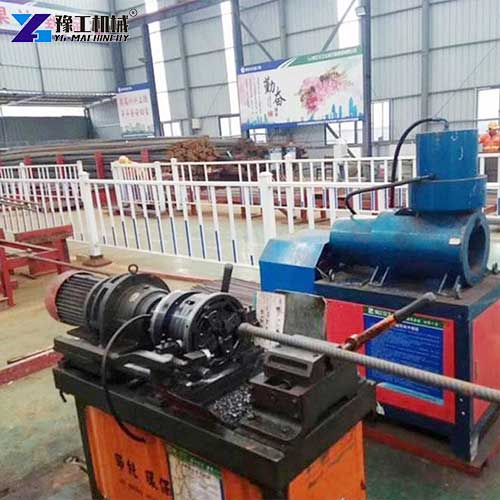
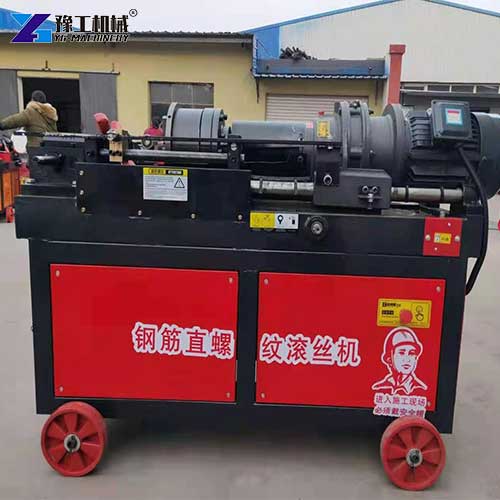
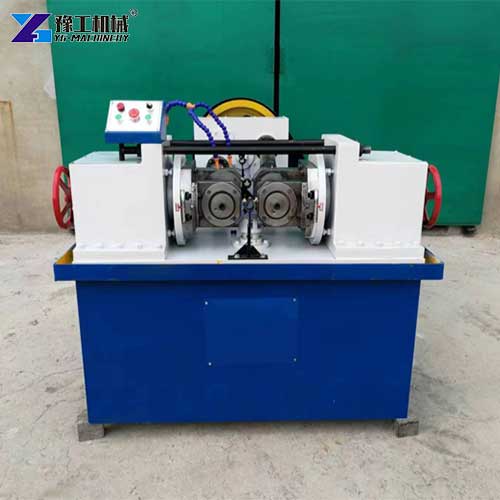
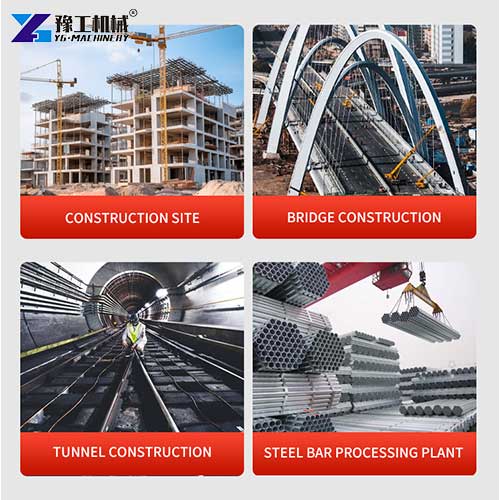
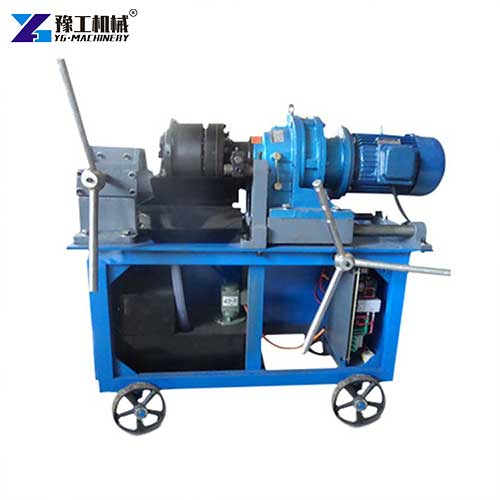
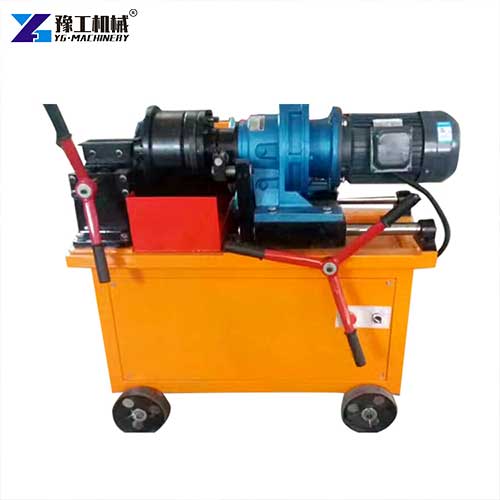
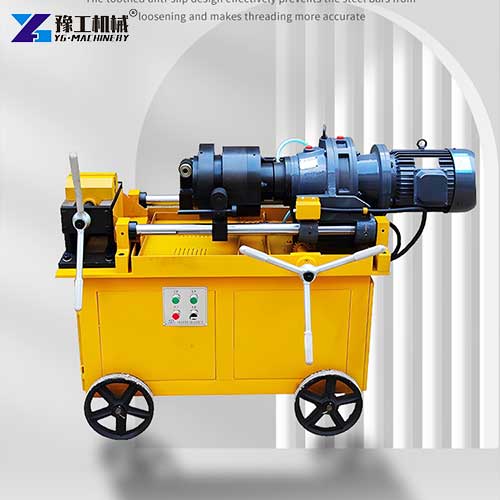
A steel threading machine is dedicated construction reinforcement equipment built to form standard straight threads on ribbed steel bar ends, serving as the core processing unit for mechanical rebar splices across infrastructure and building works. This machine adopts proven rib stripping and cold thread rolling craftsmanship, covering a universal 16- 40 mm processing diameter range that fits mainstream rebar specifications used globally. A portable rebar threading machine retains all core processing capabilities while adding flexible mobility for scattered job site zones. Every finished thread produced by this machine outperforms the base rebar material in tensile strength, fatigue resistance and corrosion resistance, eliminating structural weak points at rebar joints.
A steel bar threading machine completes rib removal and thread forming in a single clamping operation to cut repeated manual positioning errors. This steel threading machine works seamlessly with rebar upsetting machines for high-spec projects, where pre-upset rebar heads achieve even stronger connection performance after thread rolling treatment.
Steel Threading Machine Parameters:
| Model | YGS-40 | YGT-40 | YGA-40 |
| Processing diameter range | 16- 40 mm | ||
| Thread rolling length | 0-80mm | 0-80mm | 0- 100 mm |
| Power voltage | 4kw/380v 50hz | 4kw/380v 50hz | 7.5kw/380v 50hz |
| Working efficiency | 15s/forming | 8s/forming | One-touch auto forming |
| Machine weight | 320kg | 350kg | 400kg |
| Machine size | 115*50*106cm | 110*60*130cm | 126*70*106cm |
| Type | Standard type | Upgrade type | Fully automatic type |
YGS-40 – Standard Model
The entry-level choice for most applications. Uses a 4kW motor and processes 16- 40 mm rebar with 0- 80 mm thread length. Cycle time is 15 seconds per thread. Weight: 320kg. Suitable for general construction where thread length requirements are standard.
YGT-40 – Upgraded Model
Nearly twice as fast as the standard model at 8 seconds per thread. Uses the same 4kW motor and processes the same 16- 40 mm rebar range with 0- 80 mm thread length. Weight: 350kg. Ideal for higher-volume operations where cycle time affects productivity.
YGA-40 – Fully Automatic Model
The highest-specification option. Uses a 7.5kW motor and processes 16- 40 mm rebar with an extended thread length of 0- 100 mm. The defining feature is one-touch automatic operation—the operator loads the bar, presses the control, and the steel threading machine completes the entire threading process automatically. Weight: 400kg. Suitable for high-volume operations where throughput and labor efficiency are critical.
Why Are Rolled Threads Stronger Than Cut Threads?
Cut threads remove metal. The cutting tool shears away material, creating stress concentration points at the thread roots. The grain structure of the steel is interrupted. The result is a thread that is weaker than the parent material—a connection that can fail at the thread before the bar yields.
Rolled threads displace metal. The rolling dies press the steel into the thread form without removing material. The grain structure follows the thread contour, creating a continuous, uninterrupted flow of metal. The cold-working process increases surface hardness and fatigue resistance.
The practical implications are significant:
- Tensile strength increases 20-30% – Rolled threads develop higher strength than the parent bar.
- Fatigue strength increases 40-60% – Rolled threads resist repeated loading better than cut threads.
- Corrosion resistance increases 50-200% – The work-hardened surface resists corrosion better.
Case Study: Malaysia – Bridge Construction Project
Customer: A civil engineering contractor in Malaysia specializing in bridge and highway infrastructure. The company was awarded a contract for a major bridge project requiring thousands of rebar connections.
Requirements: The customer needed a reliable threading solution for 20- 32 mm rebar with thread lengths of 80- 100 mm. The project demanded high-strength mechanical splices that exceeded the tensile strength of the parent rebar—a requirement for seismic and high-load applications. The customer was sensitive to thread rolling machine price and needed a cost-effective solution that delivered consistent quality without compromising structural integrity.
Solution: YG supplied the YGA-40 fully automatic steel threading machine with a 7.5kW motor. The one-touch automatic operation allowed the contractor to process large volumes of rebar with minimal labor—one operator could manage the machine while preparing the next bar. The extended 100mm thread length accommodated the project’s coupler requirements. Operators pair the portable rebar threading machine with a rebar upsetting machine. This process enlarges the bar‑end diameter prior to threading, ensuring the thread diameter exceeds the original bar diameter, so failure occurs on the rebar bar instead of the thread joint.
Customer Feedback: The YGA-40 rebar thread rolling machine completed the threading for the bridge project ahead of schedule. The contractor reported that the automatic operation significantly reduced labor costs and improved consistency across thousands of threads. The machine’s reliability meant no downtime during the critical phase of the project.
Steel Threading Machine, Upsetter, and Coupler – How They Work Together
Many customers assume a thread rolling machine alone is enough for all rebar connections. In reality, a complete mechanical splicing system involves three pieces of equipment working together. Missing any one of them can stop a project.
1. Steel Threading Machine – Creates the Thread
The thread rolling machine is the core of the system. It rolls threads onto the rebar ends, creating the engagement surface for the coupler. It can produce both right-hand (standard) and left-hand (reverse) threads. Right-hand threads are used for most connections. Left-hand threads are used in tight spaces where the rebar cannot be rotated.
When used alone, the thread rolling machine creates threads that match the original rebar diameter. This is called “equal-strength splicing.” The connection achieves the full tensile strength of the parent bar—sufficient for most building construction projects.
2. Upsetter – Expands the Bar End
The upsetter is used before threading. It cold-forges the rebar end, increasing its diameter by 4- 6 mm. Then the rebar thread rolling machine creates threads on the expanded section.
Why go through this extra step? Because the resulting thread has a larger diameter than the original rebar. When the connection is under tension, the weakest point is the parent bar itself—not the thread. The connection fails in the bar, not in the thread. This “bar-breaks-before-thread” result is the core value of the upsetting process.
3. Coupler – Connects Two Rebar Ends
The coupler is a steel sleeve with internal threads. Two prepared rebar ends are screwed into the coupler from both sides to complete the connection. There are three types of couplers:
- Standard (right-hand) coupler: Both ends have right-hand threads. The connection is made by rotating the rebar or the coupler. Suitable for applications with adequate rebar spacing.
- Left-hand/right-hand coupler: One end is right-hand threaded, the other is left-hand threaded. Only the coupler needs to be rotated—the rebar stays in place. Essential for tight spaces where rebar cannot be rotated.
- Reducing coupler: Connects rebar of different diameters, with different thread sizes on each end.