

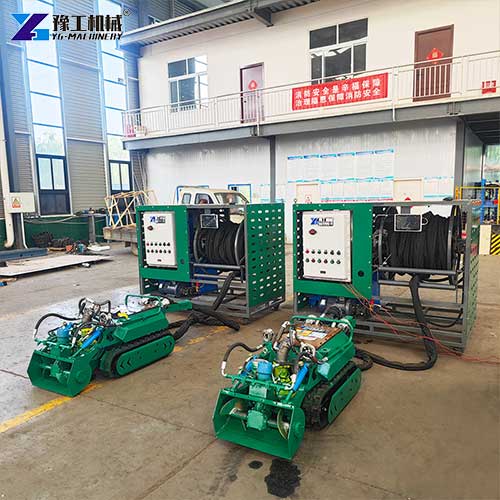
Imagine you land a 2-week sewer desilting project with a tight deadline. You call your regular crew, but half of them turn it down — no one wants to climb down dark, narrow pipes full of toxic gas and stagnant sludge. You try to hire extra workers, but labor rates have jumped 30% this year, and even then, you can’t find people with experience in confined space work. That’s exactly the gap a sludge cleaning robot fills. It is a crawler-type intelligent desilting device that drives directly into pipelines, storage tanks and riverbeds to clear sludge, sediment and debris. You operate it fully from the ground via wireless remote — no one ever has to enter dangerous, confined spaces. YG carries different underwater dredging robot models built for different use cases, from compact pipeline units to large river dredging models, covering almost every common desilting scenario.
Sludge Cleaning Robot Technical Specifications
| Parameter | YG500 | YG600 | YG700 | YG800 | YG900 | YG1200 |
| Robot Dimensions (mm) | 1500*500*650 | 1500*600*650 | 1600*700*650 | 1600*850*700 | 1650*960*750 | 1900*1200*750 |
| Dredging Width (mm) | 500 | 600 | 700 | 800 | 900 | Suitable for large culverts |
| Travel Speed (m/s) | 3–15 | 3–15 | 3–15 | 3–15 | 3–15 | 0–17 m/min |
| Pump Diameter (inch) | 3 | 3 | 4 | 4 | 4 | 4or6 |
| Pump Flow (m³/h) | 100 | 100 | 160 | 160 | 200 | 250 |
| Pump Head (m) | 0–30 | 0–30 | 0–25 | 0–25 | 0–25 | 0–30 (Horizontal: 100–150m) |
| Hydraulic Station Dimensions (mm) | 2200*1200*1700 | 2200*1200*1700 | 2200*1200*1700 | 2200*1200*1700 | 2200*1200*1700 | 2120*1240*1200 |
| Main Motor Power (kW) | 18 | 18 | 22 | 22 | 22 | 45KW (50KW) or Diesel 76KW (123KW) |
| Hydraulic System Pressure (Mpa) | 0–16 | 0–16 | 0–16 | 0–16 | 0–16 | Not specified |
| Particle Size (mm) | 15 | 15 | 40 | 40 | 50 | 0–40 (customizable) |
| Winch Speed (r/min) | 0–10 | 0–10 | 0–10 | 0–10 | 0–10 | 0–10 |
| Pipe Length (m) | 30–50 Optional | 30–50 Optional | 30–50 Optional | 30–50 Optional | 30–50 Optional | 30m/pack, 20kg pressure-resistant, optional |
| Control System | Wireless Remote | Wireless Remote | Wireless Remote | Wireless Remote | Wireless Remote | Wireless Remote |
| Lighting System | Underwater LED*2 | Underwater LED*2 | Underwater LED*2 | Underwater LED*2 | Underwater LED*2 | Underwater LED*2 |
6 Advantages of Sludge Cleaning Robot
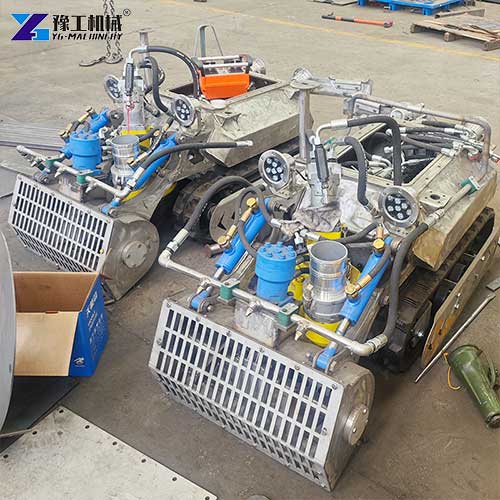
Our underwater cleaning robot has many practical advantages designed for dredging work:
- High-efficiency operation: The processing capacity can reach 100-250m³/h according to different models, which greatly improves dredging efficiency and shortens the project cycle.
- Safe and reliable: Wireless remote control operation, workers do not need to enter dangerous confined spaces, which effectively avoids the risk of toxic gas and narrow space operation, and ensures the safety of operators.
- Flexible adaptation: Crawler chassis design, suitable for pipelines, rivers, ditches, culverts and other scenarios. It can walk stably on complex underwater terrain and complete all-around dredging work.
- Large working depth: The maximum working depth can reach 30-90m, which can meet the needs of most dredging projects of different depths.
- Rich optional functions: We provide a variety of optional configurations such as explosion-proof motors, cameras and high-pressure water pumps, which can be customized according to your project needs.
- Simple operation and maintenance: The wireless remote control is easy to operate, and operators can master the operation skills after simple training. The equipment structure is simple and reliable, and the daily maintenance is very convenient.

Why Remote-Controlled Dredging Is Safer For Confined Space Projects
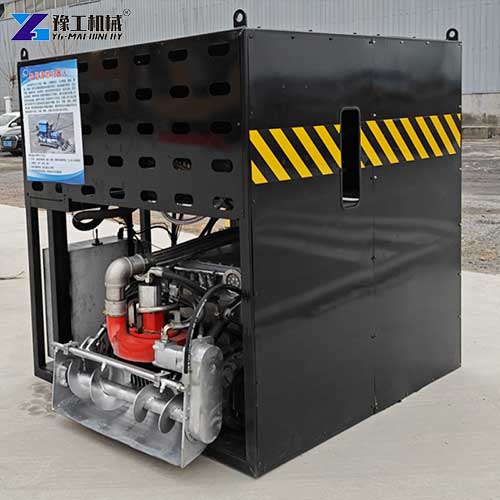
For confined space dredging projects like sewer pipelines and industrial tanks, safety is always the top priority. Traditional manual dredging has great safety risks, and more and more projects are beginning to use a remote-controlled sludge cleaning robot instead of manual work. The safety advantages of remote-controlled dredging are mainly reflected in the following three aspects:
1. Avoid exposure to toxic and harmful gases
Confined spaces such as sewers and inspection wells often contain toxic gases such as hydrogen sulfide and methane. Manual entry into these spaces can easily cause poisoning and even be life-threatening. With a remote-controlled sludge cleaning robot, workers do not need to enter the confined space at all. They only need to operate the equipment on the ground, which completely avoids the risk of toxic gas poisoning.
2. Solve the problem of narrow space operation
Many pipelines and inspection wells have very narrow spaces, and workers cannot move freely inside. This not only affects work efficiency, but also increases the risk of injury and difficulty of rescue in case of accidents. The underwater dredging robot adopts a compact crawler chassis design, which can walk freely in narrow pipelines and spaces. It can reach positions that workers cannot enter and complete dredging work more efficiently.
3. Reduce safety management costs
Manual confined space operation requires a lot of safety management work, such as gas detection, ventilation, on-site guardians and emergency rescue preparation. These not only increase labor costs but also require a lot of management time. Using a remote-controlled river sand dredging robot can greatly reduce safety management costs. You only need 1-2 operators to complete the work, and you don’t need to prepare complicated safety protection equipment.
How To Prepare Your Site Before Using A Sludge Cleaning Robot?
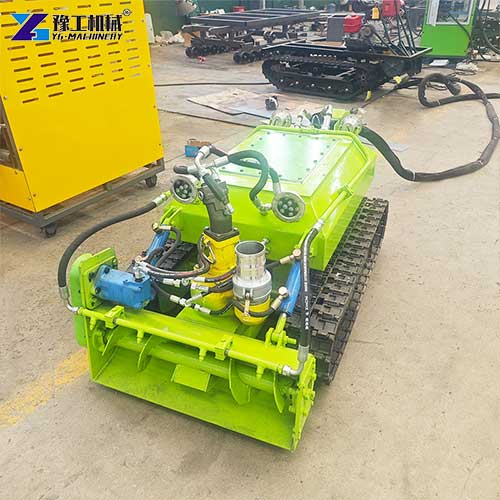
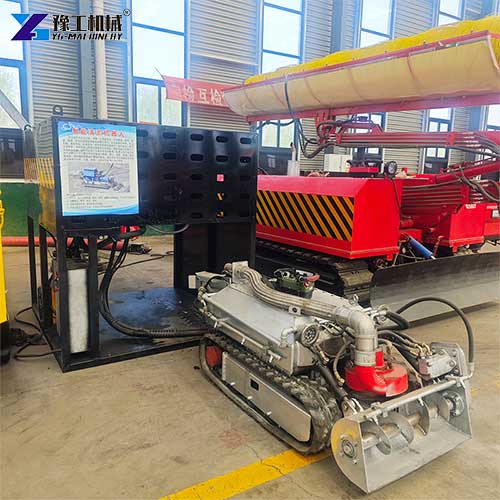
Getting your site ready before the robotic tank cleaning equipment arrives helps you start work faster and avoid unnecessary delays. You don’t need complicated preparation — just follow these 5 simple steps:
1. Check the size and condition of the work area
First, measure the size of the pipeline, tank or river section you’ll be working on. Make sure the entrance is large enough for the robot to enter, and clear any large debris that might block the robot’s path.
For pipeline projects, also check for sharp bends or diameter changes that might affect the robot’s movement. If you’re not sure if the robot will fit, you can send us the pipeline dimensions and we’ll help you confirm.
2. Set up the hydraulic station location
Find a flat, dry spot near the work entrance to place the hydraulic station. Make sure there’s enough space for the station and cable reels, and that it’s close enough to a power source (for electric models) or fuel supply (for diesel models).
The standard hydraulic oil hose is 50 meters long, so place the station within 50 meters of the work entrance. If you need a longer hose, you can order extra lengths.
3. Arrange sludge discharge and storage
Plan where you’ll discharge the pumped sludge and sediment. Make sure the discharge point is close enough to the work area and that you have proper storage containers or a designated disposal site lined up.
The robotic tank cleaning equipment uses a 4-inch sewage pipe, so make sure your discharge setup matches that size. You can buy the sewage pipe locally, or we can provide it as an optional add-on.
4. Do a basic safety check of the work area
Even though workers don’t enter the confined space, you should still do a basic safety check of the surrounding area. Make sure the entrance is stable and won’t collapse, and keep bystanders away from the work zone.
For industrial or chemical tank projects, also confirm that the sludge doesn’t contain highly corrosive materials that could damage the robot. If you’re working with special materials, ask us about our corrosion-resistant models.
5. Train 1-2 operators before starting work
The sludge cleaning robot is easy to operate, but it’s still a good idea to have 1-2 people go through basic training before the first project. We provide detailed operation manuals and video guidance, and most people master the basics in 1-2 days. Having 2 trained operators means you can run longer shifts if needed, and you’ll always have a backup if one person is unavailable.
Following these steps will help you get the most out of your robotic tank cleaning equipment and start work smoothly on day one.
If you’re tired of labor shortages, safety risks and slow progress on desilting projects, contact the YG team today. Tell us what kind of projects you do, what size pipelines or tanks you work with, and we’ll recommend the right river sand dredging robot model for you, plus a detailed cost estimate. We also provide operation training and spare parts support to make sure you get the most out of your equipment from day one.