
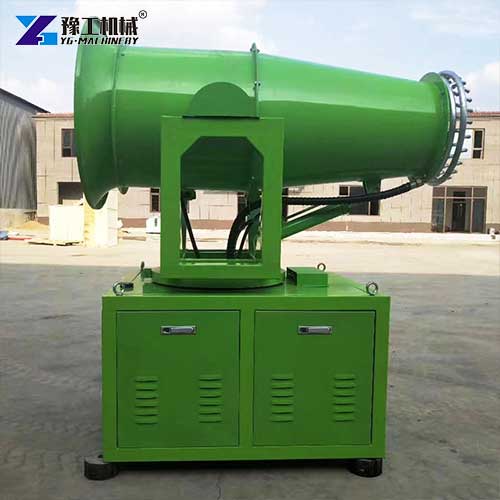
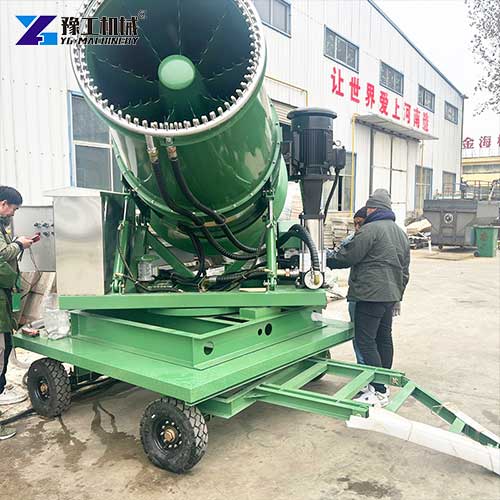
A construction materials contractor in Saudi Arabia needed a more efficient way to control airborne dust caused by aggregate loading, stockpile handling, and frequent truck movements. To address these challenges, the customer selected an 80 m YG-80 water mist cannon to direct fine mist toward key dust-generating areas and complement routine ground watering.
After deployment, the site team gained more flexible spray coverage, reduced the need to reposition hoses frequently, and improved daily dust-control operations around active loading zones. Looking for a reliable dust-control solution for your project? Explore our water mist cannon options and contact us to find the right model for your site.
What Problems Did the Customer Need to Solve?
The site team identified three practical issues.
- Dust returned quickly during busy periods. Watering the ground helped temporarily, but loading and vehicle movement disturbed dry material again.
- Manual spraying required regular attention. Workers had to move hoses between stockpiles, loading points, and traffic routes instead of focusing entirely on their assigned tasks.
- Spray coverage was difficult to maintain. A hose could wet a nearby surface, but it was less convenient for directing a fine mist across an active loading zone.
The customer was not looking for a machine to replace every dust-control measure on site. The goal was to add a long-range spraying unit that could help control airborne dust around selected work areas while keeping routine ground watering in place.
Choosing an 80 m Water Mist Cannon
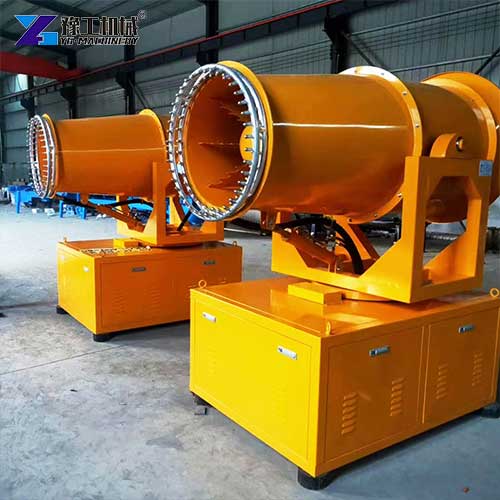
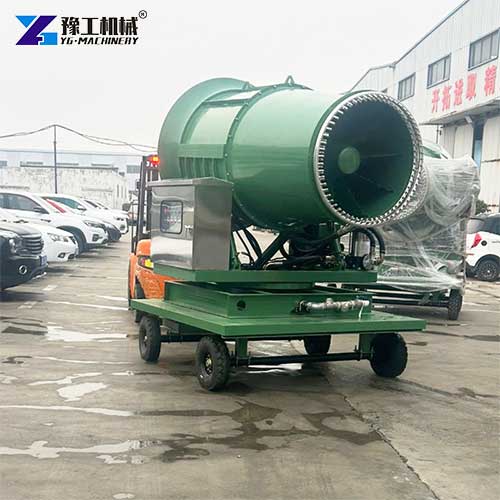
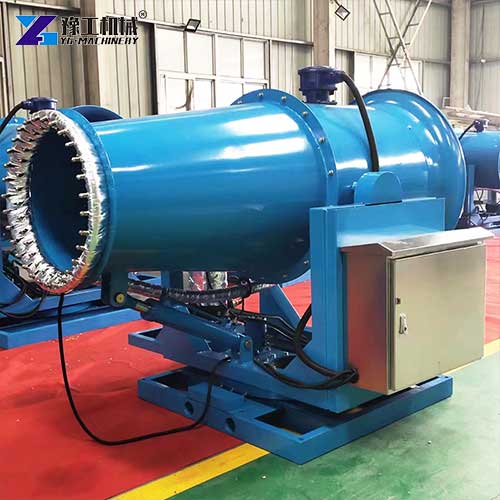
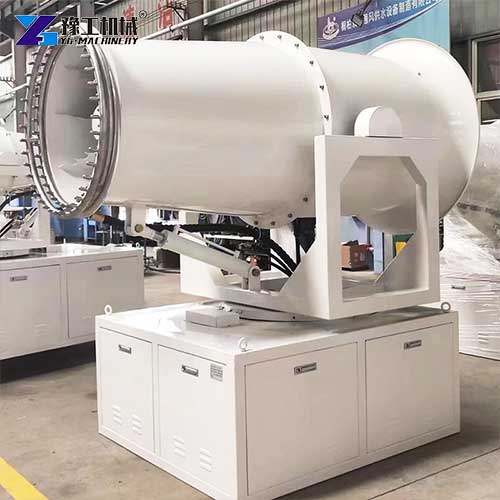
After reviewing the working area and the distance between the proposed equipment position and the main dust-generating points, an YG-80 water mist cannon was selected as the proposed configuration. Its listed spray range of 80 meters gave the site team more flexibility than a short-range unit when positioning the machine near the loading area and stockpiles.
The selection was based on the site layout and operating requirements rather than choosing the largest model available. A longer-range machine would not automatically be the best option if the main dust sources were concentrated within a smaller working area.
YG-80 Configuration
| Parameter | YG-80 specification |
| Model | YG-80 |
| Listed spray range | 80 m |
| Atomized particle size | 30–150 μm |
| Horizontal rotation angle | ±320° |
| Vertical pitch angle | -5° to 35° |
| Total power | 45.25 kW |
| Blower power | 37 kW |
| Power supply | 380 V, 50 Hz |
| Number of nozzles | 80 |
The listed specifications provide a starting point for equipment selection. Before ordering, the customer should confirm the site’s available power supply, water source, required operating flow, and actual coverage needs with the supplier.
How Was the Fog Cannon Machine Arranged on Site?
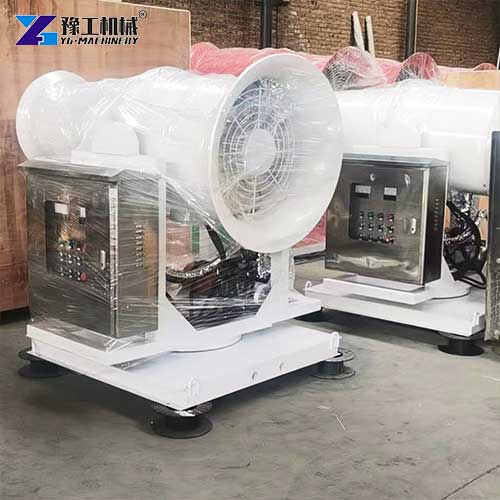
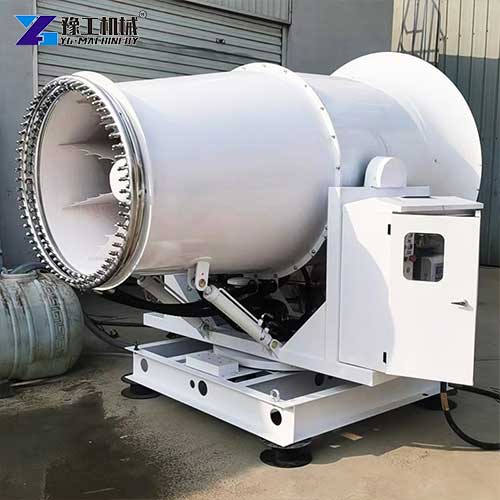
The fog cannon machine was planned for a position with a clear line of spray toward the main loading and stockpile area. The location needed to leave enough space for loader movement and truck access while allowing operators to adjust the spray direction as work shifted.
The operating arrangement focused on three areas:
- Truck loading: Directing mist toward the area where aggregate was transferred from the stockpile into truck beds, helping capture dust close to its source.
- Stockpile edges: Applying mist around exposed material when dry surfaces and handling activity caused visible dust to rise.
- Internal traffic routes: Supporting the site’s existing ground-watering routine where vehicle movement repeatedly disturbed dry soil.
The unit was intended to complement, rather than replace, other site measures. Ground surfaces still needed appropriate watering, vehicle speeds needed to be managed, and material drop heights needed to be controlled. During stronger winds, operators would need to reassess spray direction and whether conditions were suitable for the planned activity.
What Changed After Deployment?
Once the unit was positioned and its spray direction adjusted to the work area, the site team could direct mist toward dust-generating operations without moving a hose to every individual point. The main practical improvement was a more organized approach to dust control during loading and material handling.
The dust suppression fog cannon provided a wider spraying reach than a worker holding a hose at ground level. This made it easier to target airborne dust around the selected work zone, especially when loading activity was concentrated in one area.
The team could also coordinate spraying with the loader and truck schedule instead of relying only on general watering. When the loading point moved, operators could adjust the spray direction or review the equipment position to suit the new layout.
The outcome depended on wind direction, material moisture, the distance to the dust source, and the timing of spraying. The equipment was therefore treated as one part of the site’s dust-control routine, not as a guarantee that all visible dust would disappear.
Why This Type of Solution Fits Aggregate and Construction Sites
For a site with repeated loading, stockpiles, and truck movements, a long-range misting unit can provide more flexible coverage than manual hose spraying alone. Its value comes from directing water droplets toward active dust sources and making spraying easier to coordinate with daily work.
A dust suppression fog cannon is most useful when its range matches the site layout, the water supply is reliable, and operators use it alongside good housekeeping and appropriate material-handling practices. For smaller or more confined work areas, a shorter-range model may be sufficient; larger or more spread-out sites may need a different configuration.
Looking for a Suitable Dust-Control Setup in Saudi Arabia?
Choosing a machine starts with the site, not just the spray-range figure. Share your working area, the main source of dust, the distance from the proposed machine position to the target, and the available power and water supply. These details help determine whether the YG-80 or another model is more suitable.
If you are comparing dust suppression equipment for an aggregate yard, quarry, or construction project, our team can help review the required range and configuration. Contact us to discuss a suitable water mist cannon for your operating conditions.